Businesses and Policyholders
Independent policy review, risk assessment, insurer selection, political-risk review and transaction support.

Specialist, scope-based support for businesses, financial institutions, brokers and MGAs seeking clearer risk analysis, stronger insurance structures and access to broader markets.
Trade credit insurance in Australia can provide relatively narrow choices, with solutions often concentrated around traditional whole-of-turnover structures. In many cases, clients need clearer options on limits, product variety and flexibility of structure.
Internationally, credit and political risk insurance is used more broadly — including across trade, receivables, structured and project-finance contexts — and may offer wider structures and applications than those commonly available in the domestic market.
Zenith helps clients understand, assess and use credit insurance more strategically: clarifying where protection is needed, how cover can be structured, and when specialist market access or an independent view may add value.

Zenith works with organisations that need specialist credit and political risk insight — either directly or alongside existing brokers, insurers, financiers and other advisers.
Independent policy review, risk assessment, insurer selection, political-risk review and transaction support.
Credit insurance support for trade, receivables, structured and project-finance transactions.
Typical situations where a focused, specialist engagement can clarify options before renewal, placement or financing decisions.
When an existing insurer cannot provide the required limit, coverage or flexibility, including consideration of appropriate domestic or overseas capacity.
When a transaction falls outside conventional whole-of-turnover credit insurance or requires a more tailored structure.
When a business wants a second opinion on policy structure, exclusions, conditions, limits or renewal strategy, including whether the insurance remains necessary and proportionate.
When an independent credit report, risk assessment or underwriting opinion is required for a buyer, transaction, portfolio or financing structure.
When a business or financial institution needs to assess sovereign, cross-border or government-related risks that may affect payment or contract performance.
When assistance is required to interpret policy requirements, prepare a claim submission, organise supporting information or manage discussions with an insurer or broker.
Claims support does not guarantee acceptance or payment of a claim and remains subject to the terms of the relevant policy.
When credit insurance may assist trade finance, receivables finance, project finance or another structured financing transaction.
When a broker or MGA requires specialist credit and political-risk expertise, underwriting input, a second opinion or support with a complex client opportunity.
Understand the exposure, transaction, policy or business objective.
Agree the questions to be assessed, deliverables, fee and timetable.
Review the risk, structure, wording, market options and commercial implications.
Provide clear findings and, where required, support discussions with insurers, brokers, banks or other counterparties.
Every assignment is scoped according to the complexity of the matter and the level of support required.
Zenith provides focused, specialist advice on a project, transaction or defined-review basis. This means clients can obtain the particular expertise they require without automatically committing to a broader ongoing placement or servicing arrangement.
Where a client requires only an independent review, transaction assessment or specialist second opinion, this approach can be substantially more economical—and in some cases may represent only a small proportion of the cost associated with a broader ongoing engagement.
Zenith does not seek to replace a broker where full placement, policy administration and continuing servicing are required. We can work directly with the client or alongside its existing broker, insurer, financier or other adviser.
Fees and deliverables are agreed transparently before work begins.
Through KEN — Knowledge, Experience, and Novelty — we combine market understanding, practical judgement, and creative thinking to help clients navigate a specialist market where access, structure, and credibility matter.
We bring more than technical product knowledge. We bring a deep understanding of how this specialist market truly works — including the relationships, market dynamics, and international networks that often determine whether a transaction can be achieved on the right terms.
In credit and political risk insurance, access and credibility matter. Our knowledge extends beyond policy mechanics to the practical realities of negotiating with insurers across different markets.
Our advice is grounded in real market experience across both the private and public sectors, covering underwriting and, critically, claims.
This matters because many market participants may understand placement, but far fewer understand how insurers assess risk internally or how a policy is likely to respond when tested by a claim. It gives our clients practical insight that is commercially relevant from the outset.
The market is evolving quickly. Where conventional markets fall short, we help clients explore novel solutions. This may involve identifying emerging insurers, new structures, or alternative approaches that better reflect current market realities.
For more complex transactions, the ability to think beyond standard solutions can be the difference between a declined opportunity and a workable outcome.
Our work is informed by international market awareness, disciplined analysis, and an appreciation of how credibility, structure, and perspective shape better outcomes.
Even within trade finance, domestic practice can lag international markets. Policy terms, structures and negotiation outcomes are often more flexible than many buyers realise when specialist knowledge and market access are available. Credit insurance is not only a protection product; used carefully, it can support credit discipline, receivables management and, in some cases, financing discussions with banks.
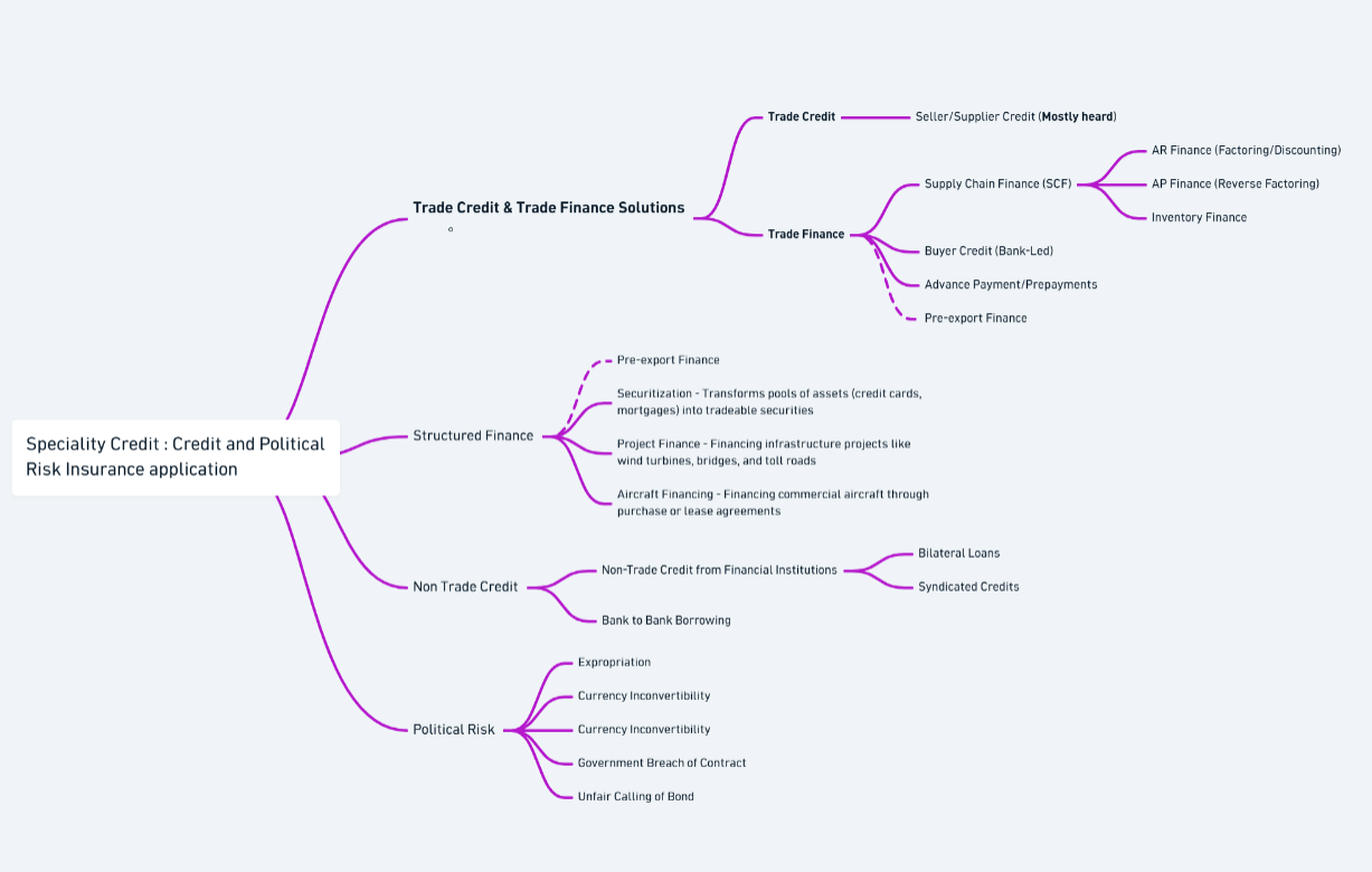
The diagram in Our Mission illustrates how specialty credit and political risk insurance can extend beyond standard short-term whole-of-turnover cover. That overview is not exhaustive — specialised global insurers often design highly customised facilities for particular transactions and jurisdictions.



Our advice is supported by more than 30 years of specialist credit-sector experience, including specialist credit insurance exposure across private and public sector markets in Australia, Asia-Pacific, and the UK.

Clive Mok CPA, BCom, BSc, MA
Email: c.mok@zenithcreditsolution.works
As a qualified CPA, Clive began his career with broad-based training across both claims and underwriting in trade credit insurance, building a practical understanding of risk from policy structuring through to claims outcomes. Since then, he has worked with several leading credit insurers across both public and private sectors, holding various roles throughout the Asia-Pacific region.
Over time, his focus expanded into structured credit and political risk insurance, where he has been involved in developing new markets and supporting more specialised financing transactions across the region. This includes experience across trade finance, receivables finance, supply chain finance, project finance, and political risk solutions, working alongside banks, brokers, insurers, and export credit agencies across multiple jurisdictions.
Clive is multilingual and experienced in cross-cultural environments, with an ability to navigate commercial and structural issues across different markets and identify the broader context behind complex transactions. He takes a practical and thoughtful approach to risk, balancing technical detail with commercial outcomes.
Beyond his longstanding interest in geopolitics and international markets, Clive has a strong interest in how artificial intelligence can be applied within underwriting and credit analysis. He believes emerging technology has the potential to improve transparency, reduce unnecessary process friction, and support more efficient outcomes for both insurers and clients—while keeping commercial judgement and human insight at the centre of decision-making.
Learn more about how Zenith works, our relationship with brokers, fees, geographical experience and the types of assignments we support.
View Frequently Asked QuestionsWe welcome enquiries from businesses, brokers, and financial institutions seeking clearer guidance on credit, trade, and political risk insurance. While our principal focus is the Australian market, we also welcome discussions involving Hong Kong, Singapore, Taiwan, and the broader Asia-Pacific region. Support is available in English, Cantonese, and Mandarin.
Have a question, comment, or matter you would like to discuss? Please feel free to get in touch.